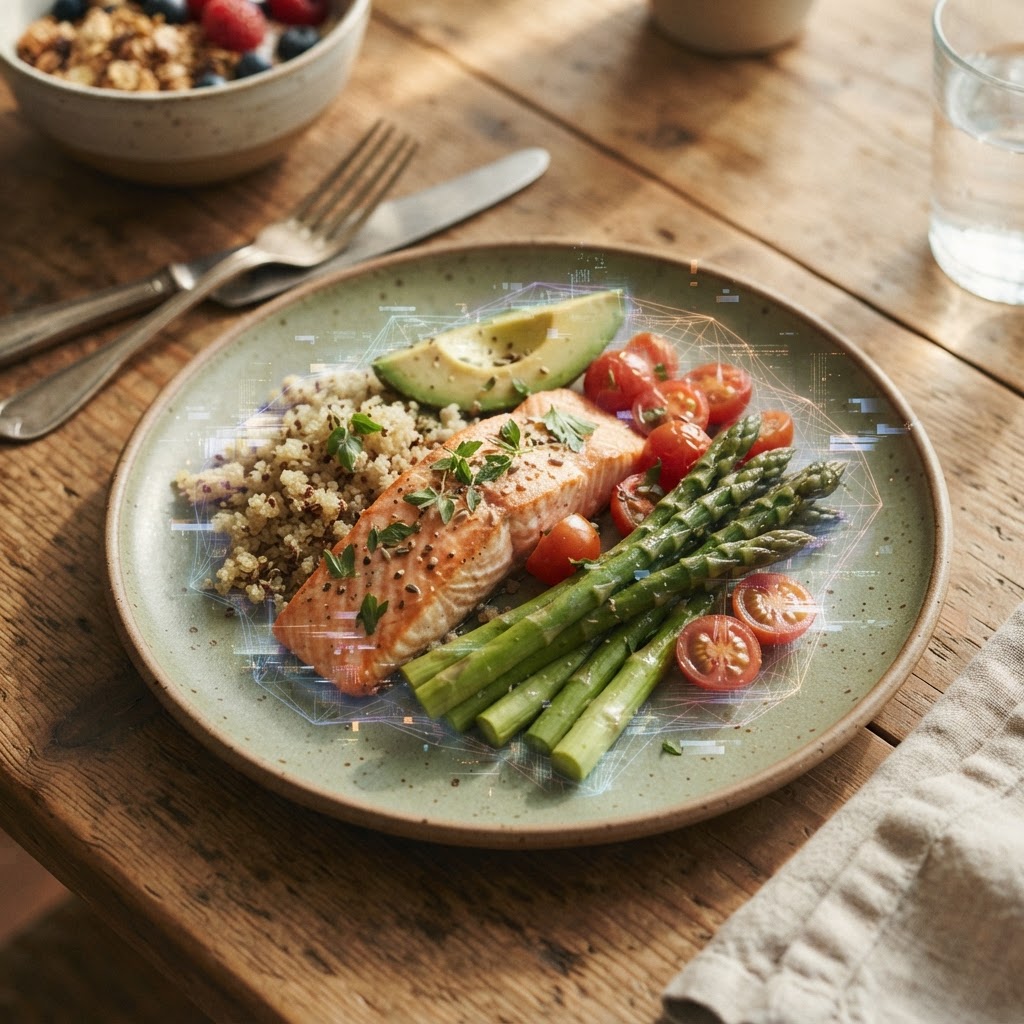
Nothing about your plate has changed. Same breakfast, same portions, same general approach to eating you have relied on for twenty years. And yet the number on the scale is moving, your energy is less steady, and the meals that used to hold you over now leave you hungry again within the hour. This is not a failure of willpower, and it is not simply "getting older" in some vague, unspecific way. Your nutritional needs have genuinely changed, and most women are never told exactly how.
What Is Actually Changing
Declining estrogen affects far more than reproduction. It changes how efficiently your body builds and maintains muscle, how it manages blood sugar, and how it responds to inflammation. One of the most significant, and least discussed, changes is something researchers call anabolic resistance: as estrogen declines, your muscles become less responsive to the protein you eat, requiring more of it, at the right times, to achieve the same muscle-building effect a younger body could manage with less.
Dr. Jamie Baum, Associate Professor and Director of the Center for Human Nutrition at the University of Arkansas, has spent her career researching exactly this intersection of protein, skeletal muscle, and the menopause transition. Her work highlights how underrepresented women have historically been in protein and nutrition research, and how much of the standard dietary advice most women received was never actually tested on a menopausal body in the first place.
Protein: Not Just More, But Different
The instinct to simply "eat more protein" is not wrong, but it is incomplete. What the research actually points to is a threshold effect: eating a meaningful amount of protein at each meal, rather than concentrating most of it at dinner, matters more than the total for the day alone. A body experiencing anabolic resistance needs a higher per-meal dose of protein to trigger the same muscle protein synthesis response.
In practice, this generally means:
- Distributing protein across breakfast, lunch, and dinner, rather than concentrating most of it at dinner, since many women unintentionally back-load their protein intake into the evening
- Understanding that this is a change in strategy, not simply a change in quantity
On total amount, the research consensus has moved beyond the standard 0.8 grams per kilogram of body weight recommendation, which was established using data from younger adults and does not account for anabolic resistance. The PROT-AGE Study Group, an international group of aging and nutrition researchers, recommends 1.0 to 1.2 grams per kilogram daily for general maintenance in older adults, rising to 1.2 to 1.6 grams per kilogram during active resistance training or intentional weight loss. Some sports scientists focused specifically on menopausal athletes, including Dr. Stacy Sims, recommend going even higher, toward 2.0 to 2.4 grams per kilogram on heavy training days. The right number for you depends on your activity level and goals, which is worth discussing directly with a provider or registered dietitian, but the broader point holds regardless of which end of that range you land on: it is meaningfully more than most women currently eat.
This same principle connects directly to the resistance training we cover in our companion piece on movement during menopause. Protein without the mechanical stimulus of resistance training, and resistance training without adequate protein, both leave meaningful benefit on the table. The two work together, not separately.
What About Creatine?
Creatine has moved well beyond its old reputation as a gym-only supplement, and for menopausal women specifically, there is a real, if still developing, evidence base worth knowing about. Women naturally have 70 to 80 percent lower creatine stores than men, which may make supplementation particularly relevant during this transition.
The most consistent finding is around muscle: a 2023 randomized controlled trial following 237 postmenopausal women over two years found that creatine, combined with resistance training, produced meaningful gains in lean body mass, benefits that did not appear in the group doing resistance training without creatine. In other words, it appears to amplify what resistance training already does, rather than working as a stand-alone fix.
The evidence on bone is more mixed than marketing claims often suggest. Some trials have found creatine reduced bone loss at specific sites like the femoral neck when paired with resistance training, while a broader 2023 meta-analysis concluded creatine does not meaningfully improve bone mineral density on its own. This is genuinely an open question in the research, not a settled benefit, and it should not replace proven bone health strategies like adequate calcium, vitamin D, and weight-bearing exercise.
Early research on mood and cognition is promising, plausibly connected to those lower baseline creatine stores in women, but researchers in this space are still describing the evidence as preliminary. If you are considering creatine, it is worth discussing dosing and appropriateness with your provider, particularly alongside any existing kidney or liver considerations.
Beyond Protein: What the Whole Pattern Looks Like
Protein is only one part of the picture. Professor Sarah Berry is a nutritional scientist at King's College London and a leading researcher specifically on nutrition and menopause. She has been vocal about separating genuine evidence from what she calls "menowashing": products and advice marketed at menopausal women with little to no science behind the claims. Her research points to two consistent, well-supported themes.
The first is the outsized impact of ultra-processed foods on menopausal symptoms and metabolic health. The second is that most women do not need a radical dietary overhaul at all. What the evidence actually supports is a small number of specific changes, made consistently, not a wholesale reinvention of how you eat.
Registered dietitians Hillary Wright and Elizabeth Ward, co-authors of The Menopause Diet Plan, translate this into a practical, sustainable framework: a largely plant-based pattern that is rich in protein and fiber, moderate in carbohydrates, and lower in saturated fat, sodium, and added sugar. None of this is a fad or a restrictive protocol. It is closer to a well-supported Mediterranean-style pattern, adjusted for the specific protein and bone health needs of this life stage.
Alcohol Deserves an Honest Mention
For a lot of women already managing a difficult symptom load, alcohol is one of the more straightforward things to reduce or eliminate. Even moderate consumption can trigger hot flashes, disrupt sleep, worsen anxiety, and interfere with how the liver metabolizes hormones. This is not a moral judgment about drinking. It is simply worth knowing that alcohol's effects on this particular transition tend to be more pronounced than they were a decade earlier.
Why Eating Less Often Stops Working
This is one of the most common frustrations women raise during this transition: eating less than they used to, sometimes considerably less, while the number on the scale stays the same or keeps climbing. It is not in your head, and it is not a sign you are not trying hard enough.
Aggressive calorie restriction, without enough protein to support it, tends to accelerate exactly the muscle loss this article has been describing. Less muscle means a lower resting metabolic rate, since muscle tissue burns more energy at rest than fat does. A lower resting metabolic rate means the same calorie intake that once maintained your weight can now cause it to climb, even though you are eating less than before. The deficit that used to work is working against you, because the body doing the burning has changed.
This is why the research consistently points toward composition over restriction. It is true that resting metabolic rate tends to decline somewhat around menopause. A controlled longitudinal study that specifically isolated menopause from ordinary aging found a decline of roughly 100 calories a day attributable to menopause itself, and a modest adjustment to total intake may genuinely be appropriate to avoid slow weight gain over time. But that is a different thing entirely from the aggressive restriction many women turn to instead. A significant calorie deficit combined with inadequate protein is often the exact combination that drives muscle loss fastest, which then makes future weight management harder, not easier. The more reliable lever is not severe deprivation. It is higher-density nutrition, more protein and fiber specifically, paired with the resistance training already covered in our companion piece, so that any modest calorie adjustment you do make comes from a smarter composition, not blind cutting.
What This Looks Like in Practice
- Protein at every meal, not just dinner, prioritizing consistency over any single large serving
- Creatine as a reasonable, evidence-supported consideration, particularly for muscle mass when paired with resistance training, discussed with your provider rather than self-prescribed
- A largely whole-food, plant-forward pattern, without needing to eliminate entire food groups or follow a restrictive plan
- Genuine skepticism toward products marketed specifically at menopause symptoms, since the evidence behind many of them remains thin
- Honest awareness of alcohol's amplified effects during this transition, even at previously comfortable levels
- Pairing nutrition with resistance training, since the two are more effective together than either is alone
The Point of All of This
Your body has not betrayed you, and your old approach to eating has not stopped working because you did something wrong. It has stopped working because the underlying biology genuinely shifted, and nobody handed you the update. Small, specific, well-evidenced changes, not a dramatic overhaul, are what the research actually supports.
Key Takeaways
- Declining estrogen causes anabolic resistance, meaning muscles need a higher per-meal dose of protein to build and maintain muscle the way they once did with less
- Distributing protein across breakfast, lunch, and dinner is more effective than concentrating it in one meal
- Protein needs rise meaningfully above the standard 0.8 g/kg guideline during menopause, with expert recommendations generally ranging from 1.0 to 2.4 grams per kilogram of body weight depending on activity level and goals
- Aggressive calorie restriction without adequate protein often accelerates muscle loss, which lowers resting metabolic rate and can make weight management harder, not easier
- Creatine, combined with resistance training, has real evidence behind it for building lean muscle mass in postmenopausal women, though its effect on bone density specifically remains genuinely mixed in the research
- Ultra-processed foods have an outsized negative impact on menopausal symptoms and metabolic health, more than any single "superfood" or supplement helps
- A largely plant-based, high-protein, high-fiber, moderate-carbohydrate pattern is well-supported by current evidence, without requiring an extreme or restrictive diet
- Even moderate alcohol consumption can meaningfully worsen hot flashes, sleep, anxiety, and hormone metabolism during this transition
- Nutrition and resistance training work best together, not as separate, unrelated strategies
Sources and Further Reading
- Baum JI et al. — research on dietary protein, skeletal muscle, and the menopause transition · Center for Human Nutrition, University of Arkansas
- Bauer J et al. — Evidence-Based Recommendations for Optimal Dietary Protein Intake in Older People: A Position Paper from the PROT-AGE Study Group · Journal of the American Medical Directors Association, 2013
- Poehlman ET, Toth MJ, Gardner AW — Changes in Energy Balance and Body Composition at Menopause: A Controlled Longitudinal Study · Annals of Internal Medicine, 1995
- Chilibeck PD et al. — A 2-yr Randomized Controlled Trial on Creatine Supplementation during Exercise for Postmenopausal Bone Health · Medicine & Science in Sports & Exercise, 2023
- Berry SE — public research and commentary on nutrition, menopause, and "menowashing" · King's College London
- Wright H, Ward E — The Menopause Diet Plan: A Natural Guide to Managing Hormones, Health, and Happiness
This platform is for educational purposes only and does not constitute medical advice. Always consult a qualified healthcare provider regarding your health and treatment options.